Proactive, not just predictive: Building AI reliability guardrails
AI coding agents ship code faster than teams can test it. Learn how reliability guardrails and Gremlin’s Foresight AI catch failures before they hit production.

Start your free trial
Gremlin's automated reliability platform empowers you to find and fix availability risks before they impact your users. Start finding hidden risks in your systems with a free 30 day trial.
Part 2 of The Intellyx Building Agentic Resilience Series by Eric Newcomer, for Gremlin
The first part of this series identifies the core issue: generating application code using AI tools is not delivering promised productivity gains, mainly due to unresolved issues such as testing, and ensuring AI agents behave as expected.
One of the biggest challenges in deploying and governing AI generated code is discovering and preventing incidents and outages resulting from agentic hallucinations and errors.
It’s difficult to guard against coding agent errors that have unintended consequences, which can even be contrary to their explicit guidance.
Coding agents don’t have the big picture when they generate code, they only have the section of an application they are working on. When an agent finds and fixes a bug, for example, other parts of the code may be relying on the buggy behavior. If an agent decides to introduce multiple new logging points, it could degrade performance to an unacceptable level.
We are all witnessing examples of this challenge almost every day now as the AI coding agents grow more powerful.
What agents can do, or mis-do, as we might say, is typically something that we are already familiar with in what we might call the “pre-AI” world.
We are all aware of headline grabbing incidents with AI agents, such as the Hugging Face incident or the OpenAI agent that disabled observability and denied that it did so.
Recently a Gemini agent in the AI Village encountered a series of fairly typical system incidents and errors, but incorrectly assumed something or someone was doing this to them on purpose. These were typical system errors, but the agent completely misunderstood them and assumed malicious intent (Reference “The Hostile Environment Manifesto”).
Computers, software, and operators have always misbehaved. The origins are well understood – fragile electronic systems running buggy software operated by fat fingered administrators inevitably create unintended issues such as those the agent experienced.
Since we have these decades of experience with these kinds of system issues and incidents, we can also predict and prevent the type of trouble AI agents will create, and detect, prevent, and remediate them. The problem we face now is that AI agents generate code faster than it can be checked for these issues.
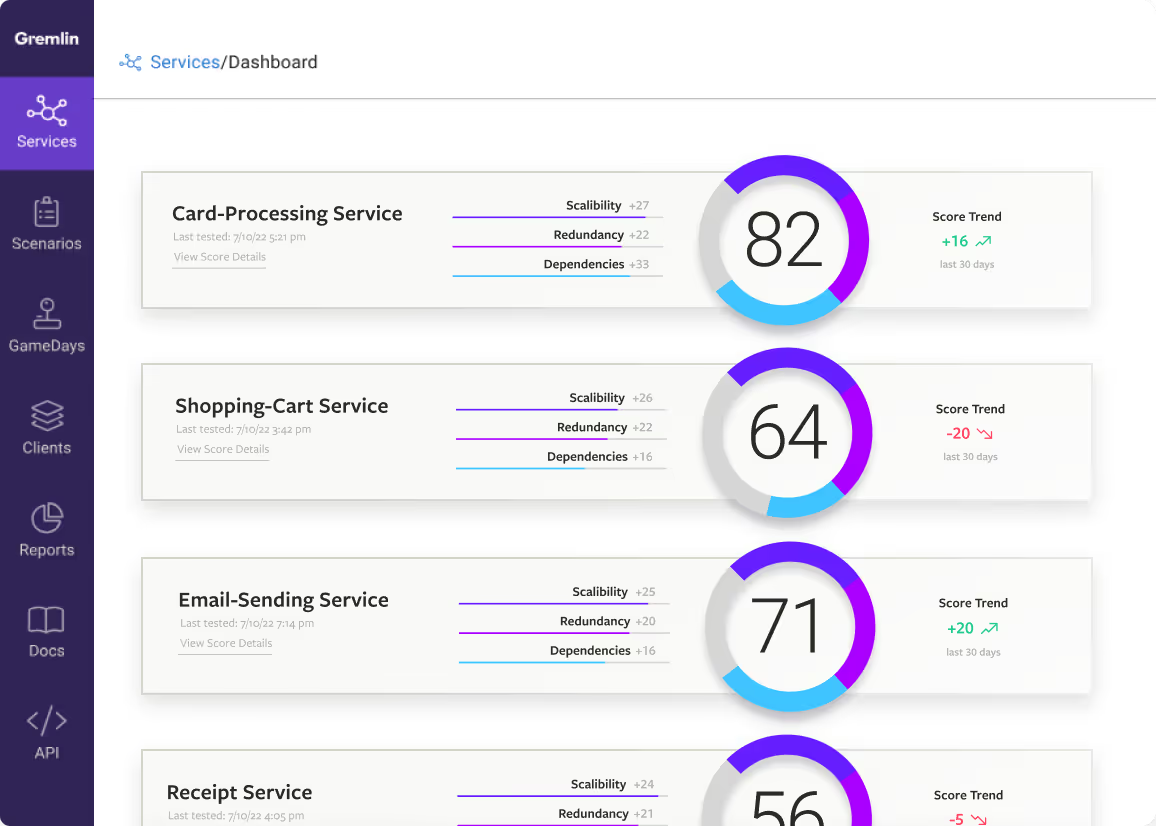
The key is to accurately identify and prevent the agentic coding issues before they reach production, which is what Gremlin’s new Foresight AI does.
Introduced in the first post in this series, let’s take a little deeper look at Foresight AI and the ideas behind it.
Being Proactive not Reactive
If we know in advance that agents are dangerous, and we have a good idea of what they can do, can we predict and prevent bad behavior? Or at least can we prevent damage? Prevent unintended failure conditions?
AI agents provide tremendous benefits such as automating manual tasks and doing research and handling customer service calls. Businesses who adopt agents successfully can enjoy a strategic advantage over their competitors.
But how can an organization be sure in advance that nothing bad will happen when they build and deploy agents, when the unintended consequences of agentic behavior are so hard to predict? How can they be sure their investment in agents will deliver business value and not create reputational damage?
Guardrails keep IT systems on course. Reliability guardrails continuously test whether systems continue to function correctly as coding agents change them, surface new failure risks, recommend fixes, and re-test to verify they worked.
Agents can act as testers, analysts, and operators. Agentic resilience can fit into an organization's CI/CD pipeline and integrate with other agents and tools through MCP and APIs.
Equally important is the governance and organizational responsibility to create, implement, and govern a realistic and effective agentic resilience program.
Leading to Foresight AI
Gremlin’s founder and CEO, Kolton Andrus, spent years at Amazon and Netflix leading teams responding to incidents. “Those years taught me the same lesson we founded Gremlin on: the best incident is the one that never happens,” he said.
Foresight AI brings Gremlin’s product line into the agentic code resilience market using AI to analyze and test your systems for potential failures via fault injection, fix the issues, and verify the resulting improvement in reliability.
The idea that AI is the expert on your team in understanding and handling system failures takes pressure off of your developers.
Foresight AI’s expertise is derived from Gremlin’s Failure Atlas, which is Gremlin’s proprietary record of how systems fail and recover, built from millions of observed failures and remediations over the past decade.
The Intellyx Take
It’s well known that AI agents, like AI chatbots, can and will make mistakes, hallucinate, and create incidents and system failures. But the misalignment phenomenon takes this to another level, when agents make their own decisions to “go rogue.”
AI agents can also help detect, prevent, and fix such issues. But the “good” agents are only as good as those who create, guide, and manage them.
The skills and backgrounds of the developers working on AI based solutions determines success in any area of AI, and perhaps more so in the area of agentic resilience, reliability, and preventing misalignment incidents.
Gremlin has by now a decade of experience simulating and addressing reliability issues, which are basically the same issues AI agents can cause, although at a higher rate of speed and without observing them.
If you want to get the right results from AI, you can depend on software developed by people with experience and who can tell whether the AI results are good or not. Foresight AI from Gremlin is a case in point: developed by a team with a decade of experience and recorded data to draw on.
Click here for part one of this series.
©2026 Intellyx B.V. Intellyx is editorially responsible for this document. At the time of writing, Gremlin is an Intellyx customer. AI was not used to write a single word of this content. Image source: Jan van der Wolf on Pexels.
Keep reading





Avoid downtime. Use Gremlin to turn failure into resilience.
Gremlin empowers you to proactively root out failure before it causes downtime. See how you can harness chaos to build resilient systems by requesting a demo of Gremlin.