Gremlin vs Open Source Chaos Tools
Compare Gremlin with Chaos Monkey, Chaos Mesh, and LitmusChaos on platform coverage, maintainability, cost, enterprise features, and functionality.
Running experiments vs. running a reliability program
Chaos Monkey, Chaos Mesh, and LitmusChaos are the open source chaos engineering tools teams reach for most, and each one does its job. Chaos Monkey terminates instances in apps you deploy with Spinnaker, while Chaos Mesh and LitmusChaos run a broad set of faults against Kubernetes workloads and some cloud resources. You control the deployment, you can extend it with custom code, and you don’t pay for a subscription.
The trouble starts when the tool works but the program around it stalls. Your engineers maintain tooling instead of building features, the tools don’t reach the systems you run outside Kubernetes, and you still can’t tell leadership which services are most at risk.
Gremlin is a reliability management platform that runs safe failure tests across Kubernetes, hosts, cloud, on-prem, and serverless, then turns the results into a reliability score for every service. If your team is small, wants free, hands-on fault injection mainly in Kubernetes, and has time to run its own solution, Chaos Mesh or LitmusChaos is a reasonable choice. If you're accountable for reliability across many teams and need to demonstrate improvements across the board, Gremlin is built for that job.
Gremlin vs. Chaos Monkey, Chaos Mesh, and LitmusChaos, side by side

Gremlin is a reliability management platform that helps teams find and fix problems before they reach users. It runs safe failure tests, detects reliability risks in your service configurations, maps service dependencies, and combines all of it into a standardized per-service reliability score. You can track those scores over time, benchmark them across teams, and show leadership that your reliability investments are paying off.
Gremlin works across bare metal, on-prem data centers, Linux and Windows hosts, AWS, Azure, GCP, Kubernetes, and serverless applications through Failure Flags. Health Checks watch your observability tools during every test and roll the test back if your systems go unhealthy. Foresight AI adds supervised agents that find risks, propose fixes for your team to review, and re-run tests to prove the fix holds.
Gremlin customers include four of the five largest US banks and hundreds of Fortune 500 companies. Gremlin is SOC 2 Type II certified, runs in an environment certified to ISO 27001 and ISO 27017, and offers Private Edition for teams that need to run the control plane inside their own network.
Three of the most widely used open source chaos engineering tools are Chaos Monkey, Chaos Mesh, and LitmusChaos.
Chaos Monkey
Netflix created Chaos Monkey to randomly terminate production instances, so its engineers would design services that survive losing one. It's famous for launching the practice of chaos engineering, and Gremlin's founders helped build the practice of production fault testing at Netflix. Netflix later open sourced it, and the current version is tied to Spinnaker. However, its last major release was in 2016, it requires a MySQL database, and it only runs one experiment: kill instances on a schedule. Our Chaos Monkey guide covers the tool in depth.
Chaos Mesh
Chaos Mesh started at PingCAP as a test harness for the TiDB database, and is now a CNCF project. It's built for Kubernetes: it runs on Kubernetes, originally only tested Kubernetes resources, and you define experiments as Kubernetes custom resources. It has since added new target types and experiment types including hosts and a small set of cloud services. Azure Chaos Studio also uses Chaos Mesh to run faults on Azure Kubernetes Service (AKS).
LitmusChaos
Like Chaos Mesh, LitmusChaos was first created by a company (MayaData) as an internal harness and later became a CNCF project. LitmusChaos is one of the more mature open source products: its ChaosCenter web UI can build multi-step experiments, it offers a public library of faults called ChaosHub, and it offers resilience probes as safety checks, similar to Gremlin's Health Checks. Harness sells a commercial product built on LitmusChaos called Harness Resilience Testing.
Where Gremlin and open source tools diverge
Platform & Infrastructure
Chaos Monkey only works with applications you deploy and manage through Spinnaker.Chaos Mesh and LitmusChaos are Kubernetes-first. Both run their control planes inside a cluster and do their best work against pods, containers, and nodes. Chaos Mesh can also target hosts through Chaosd, which you deploy separately, and both support a limited set of cloud API faults, such as stopping virtual machine instances and detaching disks. Neither gives you a full set of resource, network, and state faults on Linux and Windows hosts outside a cluster. In the open source version of LitmusChaos, host-level OS faults aren't available at all.
Gremlin runs on hosts (bare metal and virtual), containers, Kubernetes nodes, and applications via Failure Flags. The same experiments work across almost every target type, and you can group targets into services for easier management. You can create a single uniform test suite for your entire organization and run it against a bare metal fleet, VM estate, or a Kubernetes cluster, and measured against the same baseline.
Chaos Mesh and LitmusChaos are strongest inside Kubernetes. Gremlin runs the same tests on Kubernetes, VMs, bare metal, and serverless, in the cloud or on-prem, and scores every service on one scale.
Safety & Security
Fault injection tools almost always need privileged access to the systems they're testing, so the security of the tool matters as much as its capabilities. With open source tools, your team secures, maintains, and patches them. In 2025, JFrog researchers disclosed critical vulnerabilities in Chaos Mesh that could let an attacker take over a cluster in the default configuration. The maintainers fixed these in version 2.7.3, but every team running Chaos Mesh had to find out and upgrade on their own.
Run-time safety differs too. Chaos Monkey has no rollback: a terminated instance stays terminated, and recovery depends on your ability to autoscale. Checking system health before starting an experiment requires custom Go code. LitmusChaos probes monitor your systems throughout an experiment and can fail it if your service becomes unhealthy, similar to Gremlin Health Checks.
Gremlin Health Checks connect to your observability tools, whether they run in the cloud or on your private network, monitor your services continuously during every test, and roll back tests when they detect a problem. Gremlin can also create Health Checks for you. A "Halt All" button stops every running experiment at once, and blast radius controls limit experiment impact. RBAC, SSO, audit logs, and many other security control define who can run what, and where. Gremlin is SOC 2 Type II certified, runs in an ISO 27001 and ISO 27017 certified environment, and Private Edition keeps the agent and control plane behind your firewall.
Open source puts privileged fault injection components in your cluster for you to secure and patch. Gremlin ships, maintains, and supports those updates for you.
Pricing & Total Cost of Ownership
Chaos Monkey, Chaos Mesh, and LitmusChaos have no license fee, but you pay in engineering time instead. Someone has to install, upgrade, and patch the control plane in each cluster, keep its dependencies running, and maintain custom experiments and plugins for your environment. And when leadership asks which services are most at risk, someone has to build that report by hand..
Gremlin is priced by the size of your deployment, not how many tests you run. Gremlin manages the control plane (unless you use Private Edition) so your engineers can focus on the important work. We handle the updates, ships updates and new faults, and provides support. All you need to do is deploy the agent, add your services, and start testing.
If you're running open source tooling today, estimate the engineering hours your team spends operating it, add the reporting and standardization you still need to build, and price that against a Gremlin quote for your footprint. Gremlin’s build vs. buy guide walks through the math.
The license is free, but the hours aren't. Installing, maintaining, and securing the control plane, writing experiments, and building reports for leadership all cost engineering time.
Enterprise Capabilities
Open source chaos tools report on experiments. Chaos Mesh shows experiment events and history in its dashboard and integrates with Grafana. LitmusChaos calculates a resilience score for each experiment run, weighted by probes you configure, and shows experiment analytics in ChaosCenter. Chaos Monkey doesn't report at all. None of them tells you how reliable a service is across all of its tests, or how one team compares to another.
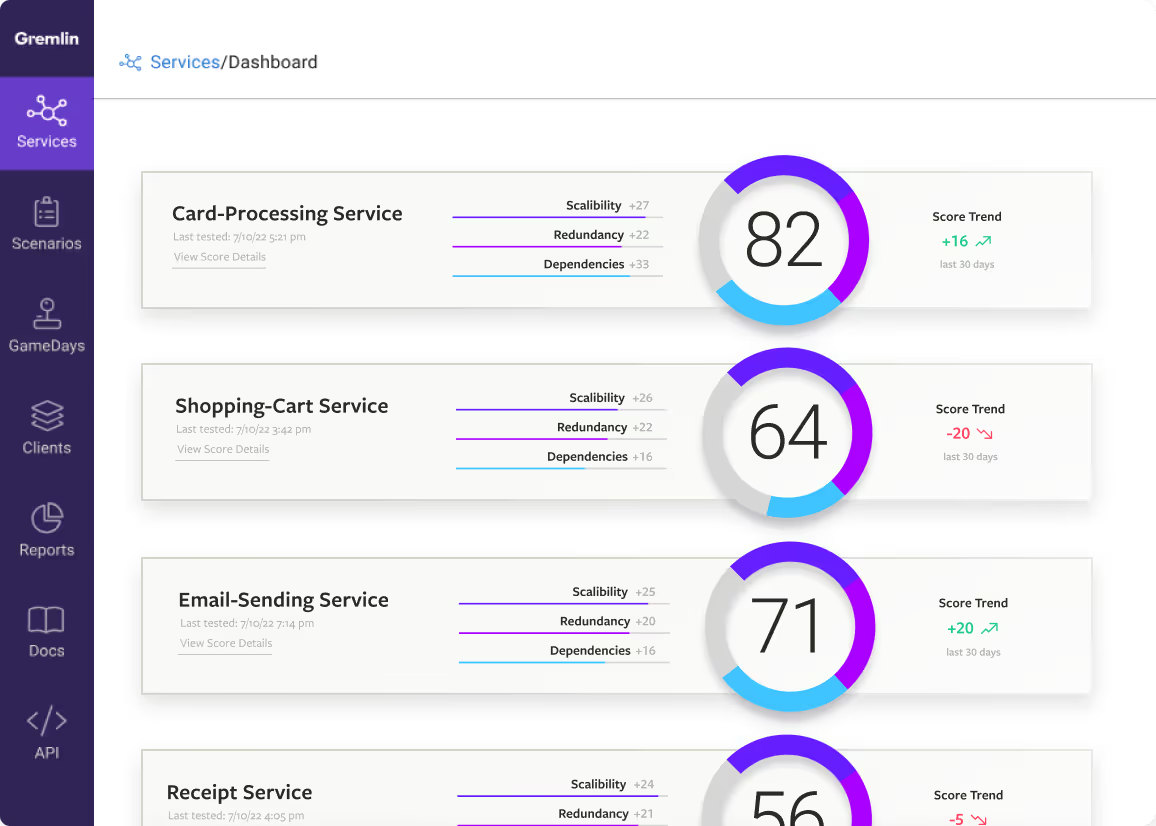
Gremlin scores every service using executed tests and Detected Risks, applies the same standardized test suites to every team, and rolls scores up by team and company leadership can see where risk sits and whether it's shrinking.
Open source programs also depend on the people who run them. When the engineer who built your Chaos Mesh workflows leaves, the knowledge of what they test and how to read the results often leaves too. Gremlin keeps test suites, results, and scores in one place that outlasts any single owner.
Open source tools tell you whether an experiment passed. Gremlin tells you how reliable each service is, using a score you can benchmark across teams and track over time.
AI Capabilities & Disaster Recovery
None of the three open source tools includes AI-driven analysis or recommendations. You decide what to test, you interpret the results, and you determine the fix yourself.
Gremlin's Foresight AI runs supervised agents that find risks across your services, propose concrete fixes like configuration patches for your team to review, and re-run failing tests to prove the risks are resolved. Its recommendations draw on the Failure Atlas, Gremlin's record of how real systems fail. A native MCP server brings Gremlin's reliability data into the AI tools your team already uses.
Disaster recovery testing is another area where open source tools fall short. You can stop virtual machines in an availability zone using LitmusChaos' cloud faults or Chaos Mesh's AWS actions, but neither tool gives you a disaster recovery workflow or an audit trail demonstrating compliance. Gremlin's Disaster Recovery Testing recreates zone and region failures from a central console and produces auditable, compliance-ready reports.
One of the largest banks in the world used Gremlin to go from running 4,000 distinct DR tests manually to completing full disaster recovery testing in a tenth of the time.
Which one is right for you?
- You need to test more than Kubernetes: bare metal, VMs, on-prem, Windows hosts, or serverless.
- You're accountable for reliability across many teams and need benchmarking and executive reporting.
- You'd rather not operate, patch, and secure privileged chaos tooling in every cluster.
- You need disaster recovery testing with auditable, compliance-ready reporting.
- You want safety features such as an automatic rollback tied to your observability tools and a single halt button for every test.
- You want AI agents that find risks, propose fixes, and verify them.
- You want vendor support and a roadmap you don't have to staff.
- You want a reliability score for each service, not a pile of experiment results.
- Your workloads run entirely on Kubernetes and you want to manage your tests as Kubernetes resources.
- You can dedicate engineering time and resources towards operating, securing, and scaling your own tooling.
- You're running a small number of experiments and don't need reporting, scoring, or multi-team support yet.
- You have extensive customizations you want to make.
- You already deploy everything with Spinnaker and only want random instance termination (Chaos Monkey).
Key Takeaway
Chaos Monkey, Chaos Mesh, and LitmusChaos are good ways to start injecting failure, and the price is right. Chaos Mesh and LitmusChaos in particular give Kubernetes teams a capable fault library at no license cost.
What they don't give you is reliability management. You get experiment results, not a score per service. You get coverage over Kubernetes, but not your whole estate. And your team runs, patches, and reports on the tooling itself, instead of focusing on building resilience. Gremlin covers every environment you run, rolls tests back automatically, scores each service on a uniform scale, and shows leadership where reliability is improving. Open source is a convenient way to get started, but for teams wanting to go beyond running ad-hoc experiments, Gremlin is more capable.
Chaos Mesh® is a registered trademark of The Linux Foundation. All other trademarks are the property of their respective owners.
Frequently asked questions
Almost any chaos engineering tool can reproduce Chaos Monkey as long as it can shut down hosts on a semi-random schedule. If you're only looking for a broader set of experiments and supported platforms, Chaos Mesh and LitmusChaos are the common go-to options. If you want to test multiple different target types with built-in safety controls, reliability scoring, and recommendations for how to resolve failed tests, Gremlin is built for that.
LitmusChaos is the closest open source equivalent: both are Kubernetes-native CNCF projects with a web UI and a broad fault library. But like other open source tools, Chaos Mesh falls short when teams have large deployments outside of Kubernetes, want vendor support, or need to report on reliability work to leadership. Gremlin handles these with comprehensive platform coverage, professional services offerings, and service-level reliability scores that you can benchmark across teams.
If you want to stay open source and Kubernetes-native, Chaos Mesh has similar capabilities. If you want a commercial product built on LitmusChaos itself, Harness Resilience Testing is one (see our Gremlin vs. Harness comparison). If you need a reliability management platform that tests every environment you run, scores each service, detects risks passively, and supports disaster recovery testing with audit-ready reporting, Gremlin is the solution to try.
Gremlin has a free 30-day trial with access to the full platform.
The license is free, but running the tool isn't, and can often cost more than commercial options. Your team installs and upgrades the control plane, maintains dependencies like MongoDB for LitmusChaos or Spinnaker for Chaos Monkey, writes and maintains code for additional functionality, and builds reporting capabilities for leadership. You save up front, but the engineering hours quickly add up. Our build vs. buy guide walks through the math.
Yes, but it's not recommended. Two tools means two safety models, two places to look for results, and two deployments to maintain. Gremlin's reliability score only reflects tests run through Gremlin, so anything done in a separate tool won't be included in your reports or test history. Using a single tool gives you the most complete picture.
Yes. You can install the Gremlin agent into your cluster with Helm and run resource, network, and state experiments against nodes, pods, and containers. Detected Risks flags Kubernetes configuration problems like missing liveness probes or single-zone deployments without running a test. The same agent model covers Linux and Windows hosts, VMs, and cloud instances, so you can test and score your Kubernetes services alongside everything else.
.svg)