Gremlin vs Harness Resilience Testing: 2026 Reliability Platform Comparison
Compare Gremlin's dedicated reliability platform vs. Harness Resilience Testing. Explore pricing, features, safety, and enterprise capabilities.
Two platforms converging — from opposite directions
Gremlin and Harness Resilience Testing have converged more than most comparisons admit. Harness's August 2026 release added agent-driven passive risk detection, per-service risk scoring, and resilience dashboards, putting it much closer to reliability management than a chaos testing tool. Both platforms run experiments across broad infrastructure, both offer AI-guided recommendations, and both provide enterprise governance.
The choice turns on coverage and coupling. Harness's most valuable capabilities assume Kubernetes workloads deployed through Harness CD — inside that boundary it's excellent, and if you already run Harness the integration is hard to argue with. Gremlin is infrastructure-first and platform-agnostic: reliability scoring validated by executed tests and passive detection across bare metal, VMs, on-prem, serverless, and multi-cloud, regardless of how you deploy. If your reliability risk is spread across a mixed estate, or you don't want your reliability program tied to a delivery platform, that's the case for Gremlin.
Gremlin vs. Harness Resilience Testing, side by side
| Gremlin Reliability management platform | Harness Resilience Testing Resilience testing module in the Harness platform | |
|---|---|---|
| What it is | Dedicated reliability management platform | Resilience testing module within the Harness software delivery platform |
| Supported infrastructure | Bare metal, on-prem, AWS, Azure, GCP, multi-cloud, Kubernetes, serverless | Kubernetes, Linux, Windows, VMware, AWS, Azure, GCP; agentless fault injection for cloud resources |
| Passive risk detection | Across every environment the Gremlin agent covers, including bare metal and on-prem | Scans Kubernetes workloads and Harness CD pipeline metadata |
| Scoring | Service-level reliability score validated by executed tests plus passive risk detection, benchmarked across teams | Resilience score per experiment, plus a per-service Resilience Risk Score derived from configuration analysis |
| Failure types | Comprehensive: state, resource, network, application, DR scenarios | 230+ faults across Kubernetes, cloud, Linux, Windows, VMware, and application runtimes |
| Safety controls | Auto rollback, global halt, granular blast radius | Experiment halt, ChaosGuard policy guardrails; rollback varies by fault type |
| Pricing | Per-agent; unlimited tests | User-based. Free tier available; Resilience Testing is an Enterprise module, not part of the Essentials bundle |
| Disaster recovery testing | Generally available; centralized DR simulation with auditable reporting | DR stage documented behind a feature flag; runs as a Harness pipeline on Kubernetes infrastructure |
| CI/CD integration | Integrates with major CI/CD tools; designed to go beyond pipeline testing | Native — resilience tests, risk gates, and PR checks inside Harness pipelines |
| Standalone product | Yes — no delivery platform required | Module of the Harness platform; deepest capabilities assume Harness CD |

Gremlin is a reliability management platform that helps you proactively identify and fix problems before they hit your users. Unlike traditional testing tools that look backwards at past failures, Gremlin gives you forward-looking reliability metrics—service-level scoring, combined active and passive assessments—that predict failures before they happen. This shifts you from reactive firefighting to proactive reliability engineering.
The platform works across your entire infrastructure: bare metal, on-prem, AWS, Azure, GCP, multi-cloud, Kubernetes, and serverless. Your team runs guided experiments that simulate real-world failures and measure how your system responds. You get recommendations on what to fix, automated rollback if something goes wrong, and organization-wide visibility into service reliability. Foresight AI adds supervised agents that find risks, propose fixes for your team to review, and re-run tests to prove the fix holds.
Gremlin customers include four of the five largest US banks, hundreds of Fortune 500 companies, and brands like Farmers, which had a 50% downtime reduction; Sephora, which migrated to Kubernetes with zero Black Friday incidents; and AutoZone, which reduced testing time by 80% and achieved more than 2x ROI. The platform is built for scale, security (SOC 2 Type II, on-prem deployment), and org-wide standardization.

Harness Resilience Testing (formerly Harness Chaos Engineering) is a module within the Harness software delivery platform, combining chaos testing, load testing, and disaster recovery testing. It ships 230+ faults spanning Kubernetes, cloud services, Linux, Windows, VMware, and application runtimes, with resilience probes that integrate with Prometheus, Datadog, Dynatrace, AppDynamics, and New Relic, plus agentless fault injection for AWS, Azure, and GCP resources.
Harness Resilience Testing is built on LitmusChaos, the CNCF project Harness originally created and continues to sponsor. It's available as SaaS, self-managed, and air-gapped, with a free tier. In August 2026 Harness introduced RT Agents, which passively read Kubernetes manifests, deployment configurations, and Harness CD pipeline histories to predict resilience, similar to Gremlin's Detected Risks. Harness also provides per-service resilience scores, flags coverage gaps in testing, and provides an API for gating CD deployments when tests fail.
Where the two actually diverge
Platform & Infrastructure
Both platforms cover a wide range of infrastructure. Gremlin runs on bare metal, on-prem data centers, AWS, Azure, GCP, multi-cloud, Kubernetes, and serverless. Harness supports Kubernetes, Linux, Windows, VMware, AWS, Azure, and GCP, with native agents for Linux and Windows hosts, agentless fault injection for cloud resources, and SaaS, self-managed, and air-gapped deployment. On raw fault-injection reach, treat these as comparable and move on.
The distinction that survives is where each platform's intelligence reaches. Harness's newer capabilities — passive risk detection, per-service risk scoring, coverage gap analysis, PR-level regression flagging — operate on Kubernetes workloads and Harness CD pipeline metadata. Inside that boundary they're strong. Outside it, you're back to running and interpreting experiments yourself.
Gremlin's agents feed one reliability model across every environment they run in. A mainframe-adjacent VM estate, a bare metal fleet, and a Kubernetes cluster all roll into the same scoring, the same standards, and the same reporting. For organizations whose reliability risk isn't concentrated in Kubernetes, that's the difference between a portfolio view and a partial one.
CI/CD integration
Harness has native CI/CD integration because it is a software delivery platform. Resilience tests run as pipeline stages, risk scans expose a REST endpoint for gating promotion, and coverage drops surface directly in pull requests. If your primary use case is validating resilience as part of shipping software, this is the strongest argument for Harness and it's a good one.
Gremlin integrates with Jenkins, GitLab CI, GitHub Actions, and other CI/CD tools, and is designed to do more than pipeline testing. You can run experiments during deployments, schedule them on a cadence, prepare for major events, and validate disaster recovery. The tradeoff is real: Harness goes deeper inside its own pipeline, Gremlin goes wider outside any pipeline.
Harness runs tests during the CI/CD pipeline via native integration. Gremlin is built for both "validate in the pipeline" and "continuously measure reliability in production."
Safety & Security
Both platforms take safety seriously. Gremlin automatically rolls back failed experiments and has a global halt button. If an experiment starts causing issues, you can stop everything immediately. Blast radius controls let you limit impact to specific services, regions, types of traffic, and percentages of traffic. Failure Flags gives you even more control by limiting impact to specific requests. For regulated industries, Gremlin is SOC 2 Type II certified, runs in an environment certified to ISO 27001 and ISO 27017, and it can be deployed on-prem with the agent and control plane behind your firewall so data never leaves your network.
Harness Resilience Testing has guardrails of its own. ChaosGuard and admission controllers block unsafe experiments, OPA-based policies enforce organizational rules, and RBAC can be scoped to specific faults, targets, users, and time windows. Experiments can be halted, though rollback behavior varies by fault type. Harness also offers self-managed and fully air-gapped deployments.
Both platforms are enterprise-grade: Harness provides compliance through a broader CI/CD platform, while Gremlin's safety architecture was designed to tightly control impact and blast radius.
Pricing & Total Cost of Ownership
Gremlin uses a per-agent pricing model with unlimited experiments. You pay for the agents running in your infrastructure and run as many tests as you want. At scale, this becomes a fixed, predictable cost that grows with your infrastructure, not test volume or team size.
Harness prices on users. There's a free tier, an Essentials bundle, and an Enterprise plan where you select modules individually. Resilience Testing is not part of the Essentials bundle — it sits in the Enterprise plan's Testing category, so you're selecting it as a module rather than buying the whole platform. Harness's chaos documentation also describes an entitlement of target "services" that accompanies licensing, where the same service tested in two environments consumes two entitlements. Get current terms from Harness, since the public pricing page and the licensing documentation describe this differently.
The structural difference holds: Gremlin's cost tracks your infrastructure, Harness's tracks your headcount. Which is cheaper depends entirely on your ratio. A large engineering organization testing a modest footprint usually favors per-agent. A smaller team responsible for sprawling infrastructure may not. Model both against your own numbers rather than trusting either vendor's framing.
Enterprise Capabilities
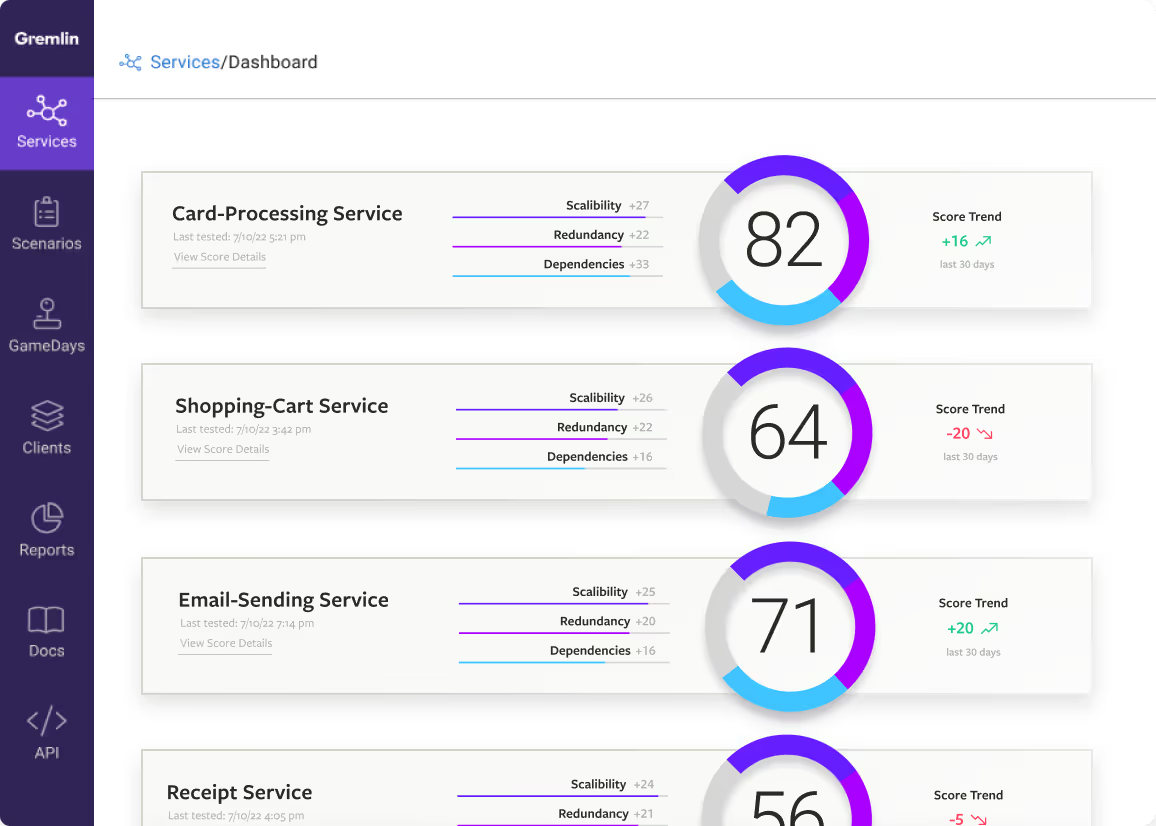
Enterprise reliability comes down to one question: can you prove it? Gremlin assigns each service a standardized reliability score built from active failure testing and passive risk detection across your environment. Standardized test suites set a common bar across hundreds of teams, scores roll up for cross-team benchmarking, and leadership gets reporting tied to what your systems demonstrably did under failure.
Harness also offers a per-service Resilience Risk Score derived from reading Kubernetes manifests, deployment configuration, and pipeline history: a prediction about how a service is configured, not a measurement of how it behaves when something breaks. Its other score reports the percentage of probes that passed in a single experiment run. Configuration analysis can flag what looks risky, but only executing the failure tells you whether failover and recovery actually hold, and that scanning reaches only Kubernetes workloads and Harness CD pipelines, leaving bare metal, VMs, and on-prem estates unscored.
Disaster recovery is where that gap becomes operational. In regulated industries, DR is an obligation you evidence to an auditor, not a dashboard metric. Gremlin's DR testing is generally available today: simulate region failures, exercise failover, and validate recovery plans from a centralized console that produces auditable, compliance-ready reporting. One of the largest banks in the world went from 4,000 manual tests to full DR testing in a tenth of the time. Harness's DR capability sits behind a feature flag you request from their sales team and runs as a pipeline stage on Kubernetes infrastructure, which is a difficult foundation for a program a regulator will examine.
If your question is "which of our 200 services is most likely to fail next quarter, and is our investment moving that number," that's the gap Gremlin is built to close.
AI Capabilities & Disaster Recovery
Both platforms have made AI central to their story, and as of August 2026 the feature lists look similar. Gremlin's Reliability Intelligence recommends which experiments to run based on your services and failure patterns, analyzes results, and suggests remediation. Harness's RT Agents read deployment configuration, manifests, and pipeline history to predict failure modes before anything runs, then generate the experiment that confirms the risk and explain the finding in plain language. Both offer MCP servers. If you evaluate on AI feature lists alone, you won't separate them.
Where they differ is the input the AI reasons over. Harness's agents analyze configuration and pipeline metadata for Kubernetes workloads and Harness CD pipelines. That's genuinely useful, and for a Kubernetes shop standardized on Harness CD it's hard to beat as a starting point. But it's inference from configuration, and it's scoped to those two surfaces.
Gremlin's recommendations are grounded in what your systems actually did when they were tested, combined with passive risk detection across every environment the agent covers — including bare metal, VMs, and on-prem estates that never touch a Harness pipeline. If your risk concentrates in a Kubernetes estate you deploy through Harness, their agents will find real problems. If it's spread across a hybrid portfolio, the coverage gap matters more than the model.
On disaster recovery: Gremlin's DR testing is generally available today. You can simulate entire region failures, test failover procedures, and validate that recovery plans work, from a centralized console with auditable, compliance-ready reporting. One of the largest banks in the world went from running 4,000 distinct tests manually to completing full DR testing in a tenth of the time. Harness markets DR testing with RTO/RPO validation and audit trails, but as of its August 2026 documentation the DR stage is still gated behind a feature flag you have to request from sales, and it runs against Kubernetes chaos infrastructure. If DR is a near-term regulatory requirement, confirm availability and scope with Harness directly before assuming parity.
Which one is right for you?
- Your reliability risk spans bare metal, VMs, on-prem, serverless, or multi-cloud rather than concentrating in Kubernetes.
- You want reliability scores validated by executed tests, not inferred from deployment configuration.
- You don't want your reliability program coupled to a specific delivery platform or CD tool.
- You need disaster recovery testing that is generally available today, with auditable, compliance-ready reporting.
- You want costs tied to infrastructure rather than headcount.
- You need a standalone platform rather than a module within a broader ecosystem.
- Your reliability practice spans teams that don't share a common CI/CD pipeline.
- You're already a Harness customer, especially a Harness CD user, and want resilience risk detection inside pipelines you already run.
- Your services are predominantly Kubernetes workloads.
- You want resilience gates in pull requests and promotion gates in your delivery pipeline.
- You want chaos, load, and DR testing managed alongside your builds and deployments.
- Your governance priority is controlling who can run which experiments, against which targets, and when.
- You want to start on a free tier before committing budget.
Key Takeaway
These platforms are closer than they were a year ago. Harness has moved beyond chaos experiments into passive risk detection, per-service risk scoring, resilience dashboards, and DR testing. Both run experiments across a broad range of infrastructure, both offer AI-driven recommendations, and both provide enterprise governance. A comparison that pretends otherwise won't survive your evaluation.
The real question is where your reliability data comes from and how much of your estate it covers. Harness builds outward from the delivery pipeline: its strongest capabilities — agentic risk detection, PR gating, promotion gates — assume you're deploying Kubernetes workloads through Harness CD. Gremlin builds outward from your infrastructure: reliability scoring validated by executed tests and passive detection across bare metal, VMs, on-prem, serverless, and multi-cloud, independent of how you ship.
If you're standardized on Harness and your risk lives in Kubernetes, Harness is a reasonable choice. If you're accountable for reliability across a mixed estate, need DR testing that's generally available today, or don't want your reliability program coupled to a delivery platform, that's what Gremlin is built for.
Frequently asked questions
"Better" depends on where your reliability risk lives. Both are mature platforms with broad infrastructure coverage, AI-driven recommendations, and enterprise governance, and Harness's 2026 releases closed much of the gap on risk detection and scoring. Harness is the stronger fit if you deploy through Harness CD, where its agents detect risk inside pipelines you already run. Gremlin is the stronger fit if your risk spans bare metal, VMs, on-prem, or multi-cloud, if you want scores validated by executed tests rather than inferred from configuration, or if you don't want your reliability program tied to a delivery platform.
Technically yes, but it's not common. You could use Harness for pipeline-gated chaos testing and Gremlin for continuous reliability management, scoring, and DR testing. However, running two platforms creates operational overhead. If you're considering both, evaluate whether one fully meets your needs before committing to two platforms.
Gremlin's per-agent model scales with your infrastructure. Harness prices on users, with a free tier, an Essentials bundle, and an Enterprise plan where modules are selected individually. Resilience Testing sits in the Enterprise plan rather than the Essentials bundle. Harness's chaos documentation additionally describes an entitlement of target services attached to licensing, where testing the same service in two environments consumes two entitlements, so confirm current terms directly with Harness. Which model costs less depends on your ratio of engineers to infrastructure; model both against your own numbers.
No. Harness Resilience Testing is a module of the Harness software delivery platform, so adopting it means adopting Harness. A free tier is available, so you don't have to buy a platform subscription to start, but the module isn't sold or deployed independently of the platform. Gremlin operates as a fully standalone platform with no ecosystem dependency.
Yes. Gremlin integrates with Jenkins, GitLab CI, GitHub Actions, and other CI/CD tools, so you can run chaos experiments as a gate in your pipeline. Gremlin is designed to go beyond pipeline testing—you can schedule experiments to run on a regular cadence, run one-off experiments for DR testing or event readiness, or automate experiment kickoff using our REST API. Harness has native CI/CD integration; Gremlin integrates with CI/CD as one use case among many.
Both platforms now produce scores, and the gap narrowed in August 2026. Harness calculates a resilience score per experiment (the percentage of probes that passed) and, with RT Agents, a per-service Resilience Risk Score derived from analyzing Kubernetes manifests, deployment configuration, and Harness CD pipeline history. Gremlin produces a service-level reliability score validated by executed tests combined with passive risk detection. The practical differences: Gremlin's score reflects what your systems actually did under failure rather than what their configuration implies, and it covers every environment the Gremlin agent runs in, while Harness's passive scoring is scoped to Kubernetes workloads and Harness CD pipelines.
Gremlin's DR testing is generally available today, with centralized simulation of region and zone failures and auditable, compliance-ready reporting—a significant advantage for regulated industries. Harness markets DR testing with RTO/RPO validation and audit trails, but as of August 2026, the DR stage is still gated behind a feature flag. If DR is a near-term regulatory requirement, confirm availability and scope with Harness before assuming parity.
Harness Resilience Testing is built on LitmusChaos. The creators of LitmusChaos founded ChaosNative, which Harness acquired in 2022. The commercial product extends the open-source foundation with a SaaS option, native Linux and Windows agents, a substantially larger fault library, enterprise governance through ChaosGuard, and integration with the Harness platform. If you use LitmusChaos directly, you only get the Kubernetes-focused open-source framework; Harness Resilience Testing adds enterprise capability and integration with the broader Harness ecosystem.
.svg)