Gremlin vs Steadybit: 2026 Reliability Platform Comparison
Compare Gremlin and Steadybit: reliability scoring, infrastructure coverage, safety controls, pricing, and DR testing. Find the right platform for your team.
Testing reliability, or measuring it?
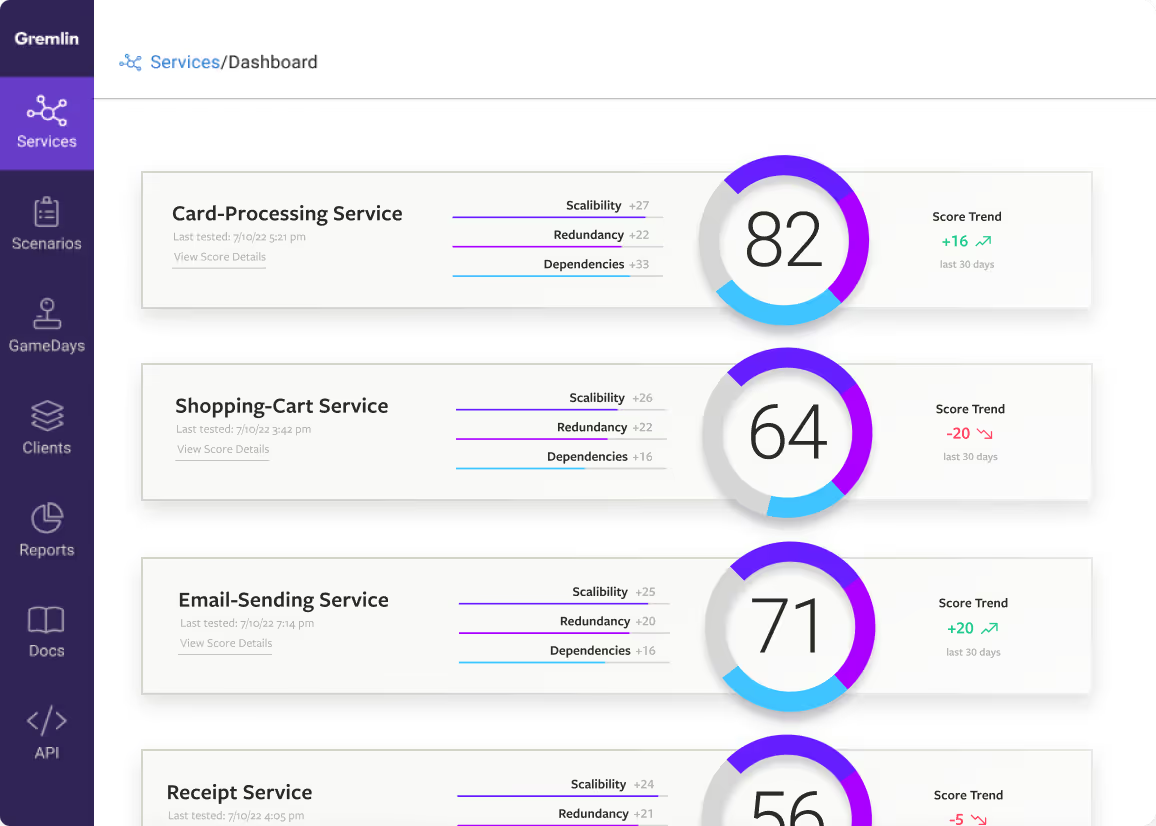
Gremlin and Steadybit are both mature platforms and offer similar feature coverage: platform support, SaaS and on-prem offerings, safety controls for managing blast radius and stopping running tests, and impact rollbacks. The main difference is what each platform is organized around. Steadybit is organized around experiments: discovering targets, designing tests, running them safely, and reporting on what happened. Gremlin is organized around measurement: a service-level reliability score that combines executed failure tests with passive risk detection, benchmarked across teams and tracked over time, plus disaster recovery testing built for audit.
If you want to give your engineers a broad "kitchen sink" chaos testing tool, Steadybit is a strong choice. But if you're accountable for reliability across a portfolio of services and want a tool that can guide you through running an effective reliability program, that's the job Gremlin is built for.
Gremlin vs. Steadybit, side by side

Gremlin is a reliability management platform that helps you proactively identify and fix problems before they hit your users. Unlike traditional testing tools that look backwards at past failures, Gremlin gives you forward-looking reliability metrics, including service-level scoring that combines active and passive assessments, so you can predict failures before they happen. This shifts you from reactive firefighting to proactive reliability engineering.
The platform works across your entire infrastructure: bare metal, on-prem, AWS, Azure, GCP, multi-cloud, Kubernetes, and serverless. Your team runs guided experiments that simulate real-world failures and measure how your system responds. You get recommendations on what to fix, automated rollback if something goes wrong, and organization-wide visibility into service reliability. Foresight AI adds supervised agents that find risks, propose fixes for your team to review, and re-run tests to prove the fix holds.
Gremlin customers include four of the five largest US banks, hundreds of Fortune 500 companies, and brands like Farmers, which cut downtime by 50%; Sephora, which migrated to Kubernetes with zero Black Friday incidents; and AutoZone, which reduced testing time by 80% and achieved more than 2x ROI. Gremlin is SOC 2 Type II certified, runs in an environment certified to ISO 27001 and ISO 27017, and can be deployed entirely inside your network with Private Edition.

Steadybit is a reliability assessment and chaos engineering platform built by Steadybit GmbH. It combines continuous target discovery, a visual Landscape Explorer for seeing how components are distributed across zones and regions, and a no-code experiment editor that makes designing and running experiments unusually fast.
Its Reliability Advice feature continuously analyzes discovered targets against best practices, shipping with 13 Kubernetes checks based on the open source kube-score project, and lets you author custom Advice to encode internal standards. The Reliability Hub offers 200+ open source actions, targets, and templates covering Kubernetes, Docker, Linux and Windows hosts, AWS, Azure, GCP, Kong, Istio, Kafka, and observability and load testing tools, and ExtensionKits let teams write their own in any language.
Steadybit is SOC 2 audited and enterprise-capable. Its architecture is deliberately lightweight, with one agent per network boundary and capabilities delivered as extensions you deploy. The main consideration for buyers is scope: Steadybit is built to find and validate weaknesses, not to produce a service-level reliability measurement across a portfolio to help you manage your reliability program more effectively.
Where the two actually diverge
Platform & Infrastructure
Both platforms cover similar ground. Gremlin runs on bare metal, on-prem data centers, AWS, Azure, GCP, multi-cloud, Kubernetes, and serverless. Steadybit likewise covers Kubernetes, Docker, Linux and Windows hosts, VMs, and cloud services across AWS, Azure, and GCP. Gremlin experiments are platform-agnostic, whereas Steadybit's library tend to consist of specific actions for specific platforms. Both offer on-prem deployment, and both can be extended with custom experiments (Failure Flags in Gremlin, extension kits in Steadybit).
Where Gremlin goes further is the application layer. Failure Flags inject faults inside application code, which reaches managed runtimes that infrastructure-level testing can't touch cleanly and lets you scope impact to a single request, customer, or user attribute. A major apparel company used Failure Flags to prove that a Lambda-based payment service failed over correctly between regions, and had the test running in under 30 minutes. Steadybit reaches serverless through cloud extensions at the function and service level, which covers many scenarios but not request-level targeting inside a running application.
Both platforms also vary in how they present your infrastructure. Steadybit discovers targets so you can design experiments against them. Gremlin also discovers targets, organizes them into services, and presents them uniformly. You can run the same standard suite of tests whether your service is a bare metal fleet, a VM estate, or a Kubernetes deployment, rather than three separate sets of experiment results.
Both platforms reach roughly the same infrastructure. The difference is what each one does with that reach: Steadybit discovers targets to test, while Gremlin presents targets using a standard, uniform reliability model.
Safety & Security
Both platforms are built to run failure tests safely at scale, and buyers should treat this as table stakes rather than a deciding factor. Gremlin automatically rolls back failed experiments and provides a global halt that stops everything immediately. Blast radius controls limit impact to specific services, regions, traffic types, and percentages of traffic, and Failure Flags narrows that further to individual requests. Health Checks continuously monitor your infrastructure and observability tools and roll back experiments that breach your SLOs. Gremlin is SOC 2 Type II certified, runs in an ISO 27001 and ISO 27017 certified environment, and offers Private Edition with the agent and control plane inside your firewall.
Steadybit also provides blast radius controls, pre-flight checks via webhooks, an "Emergency Stop" button available to anyone in the organization, and automatic rollbacks if an agent loses connection to the platform. Both platforms provide RBAC, MFA, team-based user management, and an on-prem option.
A key architectural difference between the two platforms is extensibility. Steadybit delivers much of its capability through extensions, many of them open source, that you must deploy and maintain yourself. That's what makes the platform extensible, but it means some of the surface running inside your environment is code your team is responsible for updating. Gremlin's equivalent capabilities are built into the platform and fully supported as part of it.
Both platforms have strong safety features. The main difference is architecture: Steadybit requires you to deploy and manage extensions, while Gremlin builds all of its capabilities into the platform.
Pricing & Total Cost of Ownership
Gremlin uses a per-agent model with unlimited experiments. Cost scales with your infrastructure, not your team.
Steadybit offers two plans, Professional and Enterprise, also with unlimited usage and teams. Steadybit also allows unlimited agents and only needs one agent deployed per network boundary, but this does not include extensions, which will need to be deployed to your test targets. Enterprise features such as on-prem installation, SAML, audit logs, reporting, custom property management, and pre-flight webhooks are only available in the Enterprise plan.
The best way to evaluate price is to get quotes using your infrastructure size, user count, and network topology, and compare what's included at each tier. Pay particular attention to which capabilities are gated behind Steadybit's Enterprise plan, since on-prem, SAML, audit logging, and reporting are often assumed to be standard in an enterprise evaluation.
Enterprise Capabilities
Enterprise reliability comes down to one question: can you prove it? Gremlin answers with evidence. Every service gets a standardized reliability score built from active failure testing, where Gremlin breaks the service and measures the response, combined with passive risk detection across your environment. Scores roll up for cross-team benchmarking, standardized test suites set a common bar across teams, and leadership gets reporting tied to what your systems demonstrably did under failure.
Steadybit reports on testing activity, which experiments ran and what passed, and on best-practice compliance for Kubernetes targets. Neither answers the questions an engineering leader actually gets asked: which of our services is most likely to fail, and is our investment moving that number? That's the gap Gremlin is built to close, and it's the reason to choose it over tools that are equally capable at running experiments.
Steadybit tells you which experiments ran and which best practices your Kubernetes workloads pass. Gremlin tells you how reliable each service is, on a number leadership can benchmark across teams and track over time.
AI Capabilities & Disaster Recovery
Gremlin's Reliability Intelligence uses AI built on decades of reliability expertise to guide your reliability program. It recommends which experiments to run based on your services and failure patterns, analyzes results, and suggests remediation. It goes beyond "here's why this experiment failed" to "here's what to fix and why it's a priority." A native MCP server lets you power your preferred AI tools with Gremlin's reliability data.
Steadybit's Reliability Advice also recommends experiments. It continuously checks discovered targets against best practices and points you toward the experiment that validates a given weakness, which is more than most tools in this category offer. What it doesn't do is close the loop: the checks tell you what looks non-compliant, not what your systems did under failure or which fix would move your reliability needle the most.
Disaster recovery is the clearer gap. Gremlin's DR Testing is generally available, with centralized simulation of region and zone failures and auditable, compliance-ready reporting. One of the largest banks in the world went from running 4,000 distinct tests manually to completing full DR testing in a tenth of the time. Steadybit has no dedicated DR workflow. You can approximate parts of it with cloud extensions, but you'd be assembling a compliance process out of general-purpose experiments.
Which one is right for you?
- You need a standardized, comparable reliability score per service, not just a record of which experiments passed.
- You're accountable for reliability across a large portfolio and need cross-team benchmarking and executive reporting.
- You want comprehensive risk detection spanning bare metal, VMs, on-prem, and multi-cloud, not just best-practice checks focused on Kubernetes.
- You need disaster recovery testing with auditable, compliance-ready reporting.
- You want request-level fault injection inside application code through Failure Flags.
- You want AI-guided recommendations on what to fix, not just what to test.
- You prefer platform capabilities that are built in and vendor-supported, not assembled from extensions you maintain.
- Your workloads are primarily Kubernetes, containers, and cloud-native services.
- You value an open source extension ecosystem and want to write custom actions, targets, and checks in your own language.
- You're in Europe and value a vendor with local presence, support, and DORA familiarity.
- You want to start with developer-created custom experiments rather than expert-designed and recommended experiments.
Key Takeaway
Both platforms run chaos experiments well, across comparable infrastructure, with real safety controls and real enterprise governance. The difference is what you get back.
Steadybit is organized around experiments: discover targets, design tests, run them, report on what happened. Gremlin is organized around measurement: every test and every passively detected risk feeds a service-level reliability score that can be benchmarked across teams, tracked over time, and presented to leadership, plus DR testing built for auditors rather than assembled from general-purpose faults.
If you want engineers to have a fast, flexible, extensible testing tool, Steadybit is a strong choice. If you're accountable for reliability across an enterprise service portfolio and need to prove it's improving, that's what Gremlin was built for.
Frequently asked questions
"Better" depends on what you need. Both are mature platforms that run chaos experiments safely across a broad range of infrastructure. Gremlin's advantage is measurement: a service-level reliability score combining executed tests with passive risk detection across your whole estate, plus generally available disaster recovery testing with compliance-ready reporting. Steadybit's advantage is its extension model and speed to first experiment. Evaluate on whether you need to measure and report reliability across a service portfolio, or to give engineers a fast, flexible testing tool.
You could, but it's uncommon and adds overhead: two agents to deploy, two experiment inventories, two safety models, and two sources of truth for reliability data. Both platforms are designed to be the primary system. If you're evaluating both, pick based on whether your priority is portfolio-level reliability measurement or fast, flexible experiment authoring.
Gremlin charges per agent with unlimited experiments, so cost scales with the infrastructure you cover. A single plan gets you access to the full platform. Steadybit publishes two plans, Professional and Enterprise. Both include unlimited usage, but only Enterprise provides features like SAML, audit logs, reporting, and pre-flight webhooks.
Not in the same form. Steadybit's Reliability Advice continuously checks discovered targets against best practices, with 13 Kubernetes checks out of the box based on the open-source kube-score project, plus custom checks you write yourself. That's a compliance signal against a checklist, and it's Kubernetes-centric by default. Gremlin produces a service-level reliability score that combines executed failure tests with passive risk detection across every environment the agent covers, so the number reflects how a service behaved under failure rather than whether its configuration matches a best-practice list.
Yes. Steadybit is SOC 2 audited, supports SAML and OIDC single sign-on, offers role-based access control scoped to teams and environments, keeps an audit log, and ships on-prem and air-gapped installations with full feature parity. Enterprise buyers should evaluate it on capability fit rather than enterprise readiness. The gap relative to Gremlin is in reliability measurement and reporting: Steadybit reports on experiment activity and best-practice compliance, not on a service-level reliability score that leadership can benchmark across teams, and it has no dedicated disaster recovery testing workflow.
Steadybit has no dedicated disaster recovery testing workflow. You can build experiments that simulate zone or region-level failures using its cloud extensions, but you'd be assembling DR testing from general-purpose chaos experiments rather than running a purpose-built process, and you wouldn't get the auditable, compliance-ready reporting that regulated DR programs require. Gremlin includes centralized DR simulation with auditable reporting. One of the largest banks in the world went from running 4,000 distinct tests manually to completing full DR testing in a tenth of the time.
If you have unusual infrastructure, Steadybit's extensibility is hard to match. The tradeoff is that many capabilities are provided as components that you must deploy, update, and support yourself. Gremlin's equivalent capabilities are built into the platform and supported as part of it. You only need to deploy an agent, and you get Gremlin's full feature set for that platform.
.svg)