Gremlin vs AWS FIS: Multi-cloud reliability management vs. AWS fault tool
Compare Gremlin and AWS Fault Injection Service across infrastructure coverage, safety, pricing, enterprise features, and AI capabilities. See which tool fits your reliability needs.
One tool covers AWS. The other covers everything — starting with AWS.
Gremlin is an enterprise reliability management platform that helps organizations measure, manage, and improve reliability across their entire infrastructure — including AWS, where it supports the same services FIS does (and more), plus bare metal, on-prem, Azure, GCP, and multi-cloud environments. AWS Fault Injection Service (FIS) is a managed fault injection tool scoped exclusively to AWS.
If your entire stack runs on AWS and you need a lightweight way to run fault injection tests on individual services, FIS gets you started quickly. But if you want to go beyond individual tests — measuring reliability across hundreds of services, giving engineering leadership forward-looking data, running on multi-cloud or hybrid infrastructure, or simply getting more out of your AWS testing with reliability scoring and org-wide management — Gremlin does all of that, starting with the same AWS services FIS covers.
Gremlin vs. AWS FIS, side by side
| Gremlin Reliability management platform | AWS FIS Fault injection for AWS | |
|---|---|---|
| What it is | Reliability management platform | Fault injection for AWS services |
| Supported AWS services | Any experiment on EC2, ECS, EKS, Lambda, and more; network experiments on any AWS service | Limited experiments on EC2, ECS, EKS, Lambda, and select AWS services |
| Supported platforms | Azure, GCP, bare metal, on-prem, multi-cloud | AWS only |
| Failure types | State, resource, network, application, and disaster recovery (DR) scenarios | Select fault types for each supported AWS service |
| Enterprise features | Standardized test suites, executive dashboards, cross-team benchmarking | Resilience Hub governance (AWS-scoped) |
| Reliability scoring | Per-service scores with org-wide benchmarking | Not available |
| Safety controls | Auto rollback, global halt, automatic health checks and observability integrations | Per-experiment stop conditions, some CloudWatch integration |
| AI capabilities | Reliability Intelligence with expertise-driven recommendations, native MCP server | Recommendations require a separate service (AWS Resilience Hub) |
| Disaster recovery testing | Centralized DR simulation with auditable reporting | Limited fault simulation that varies by service |
| On-prem deployment | Yes | No |
| Security | SOC 2 Type II, GDPR, ISO 27001, ISO 27017 | AWS shared responsibility model |
| Pricing | Per-agent (scales with your infrastructure) | Per action-minute (scales with usage) |

Gremlin is a reliability management platform used by hundreds of the world's largest enterprises—including four of the five largest US banks—to systematically measure, manage, and improve the reliability of their services and applications.
Gremlin works everywhere your applications run: AWS (including EC2, ECS, EKS, Lambda, and more), Azure, GCP, Kubernetes, bare metal, on-prem, and hybrid environments. On AWS, Gremlin can run the same kinds of fault injection experiments as FIS—resource exhaustion, network disruption, state changes—with the addition of a broader reliability management framework that includes reliability scoring, automated test suites, passive risk detection, dependency mapping, and executive reporting.
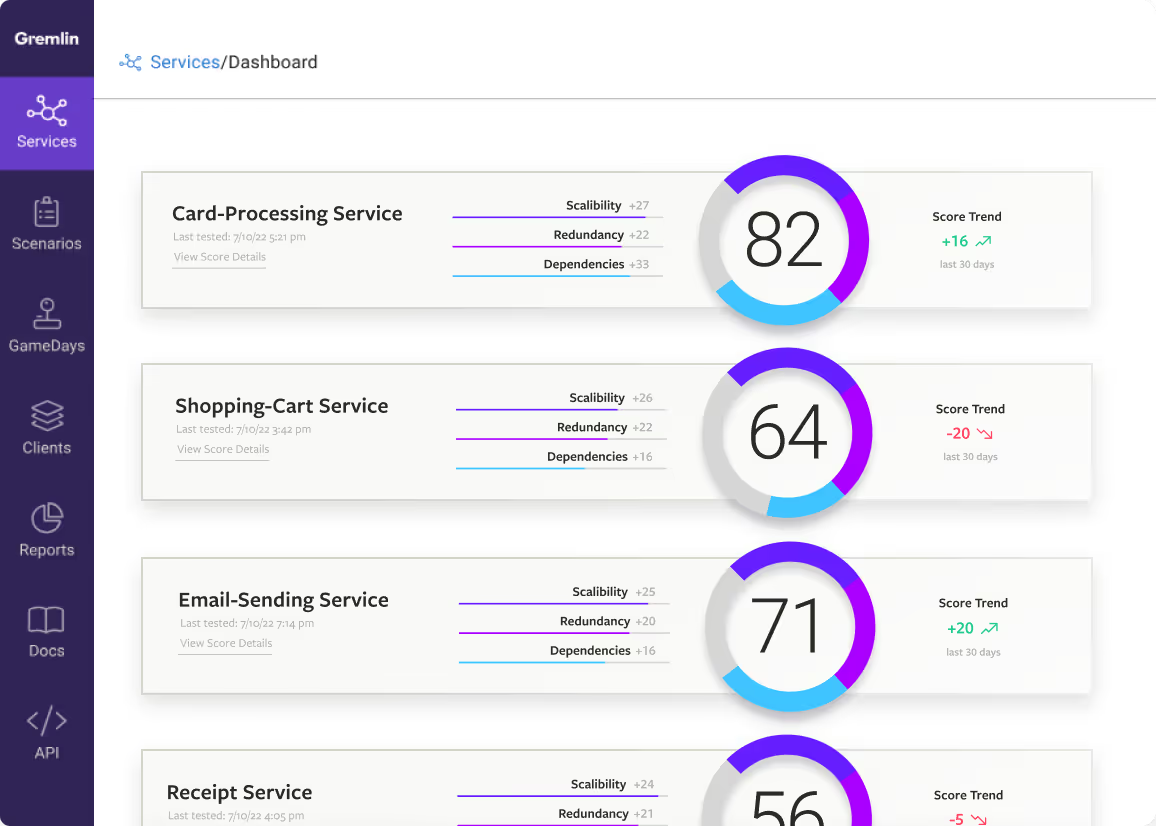
Unlike traditional chaos engineering tools that focus on running individual experiments, Gremlin combines active failure testing and passive risk detection to produce a standardized reliability score for each service. Those scores roll up across teams, giving engineering leaders a forward-looking reliability metric that they can use to prioritize investments, track progress, and prove results to leadership. It's purpose-built for enterprise organizations where reliability is a business-critical concern, and where the cost of an outage goes far beyond engineering time.

AWS Fault Injection Service (FIS) is a managed AWS service that lets you run fault injection experiments against AWS resources. Combined with AWS Resilience Hub, it provides policy-based resilience testing and governance for applications built on AWS.
FIS integrates tightly with the AWS ecosystem: CloudWatch for monitoring, Systems Manager for execution, and Resilience Hub for governance policies. If you're an AWS-native team looking to run targeted fault injection tests on supported AWS services, FIS offers a low-barrier entry point that leverages your existing AWS environment.
Five dimensions that matter at enterprise scale
Platform & Infrastructure
Gremlin is a fully-featured fault injection and reliability management solution. It supports EC2, ECS, EKS, Lambda (via Failure Flags), and other AWS services with the same categories of experiments FIS offers: resource exhaustion (CPU, memory, disk, I/O), network faults (latency, packet loss, DNS, blackhole), and state changes (process kill, shutdown, time travel). Gremlin can also run network faults on any AWS service by treating it as a dependency. The key difference: Gremlin doesn't stop at AWS. It also runs on Azure, GCP, bare metal, on-prem data centers, and multi-cloud architectures — every layer from infrastructure through application.
AWS FIS is scoped to AWS. It supports several AWS services (DynamoDB, EC2, ECS, EKS, Lambda, and more), but can't reach outside the AWS ecosystem. If you run workloads on-prem, use Azure or GCP alongside AWS, or have bare metal infrastructure, FIS can't test those systems. FIS is unique, though, in that it can simulate specific faults by interacting directly with the AWS API.
Safety & Security
Both tools have safety mechanisms, but they differ significantly in depth.
Gremlin provides automatic rollback on all experiments, a global halt button that stops all running tests, and automatic halt conditions tied to your observability monitors via Health Checks (including Intelligent Health Checks for AWS, which create monitors for you). You have precise control over blast radius: target specific resources, group targets by tag, and selectively include or exclude new targets. For security, Gremlin adheres to SOC 2 Type II, GDPR, ISO 27001, and ISO 27017. For regulated industries, Gremlin can run entirely within your private network — agent and control plane behind your firewall.
AWS FIS offers configurable stop conditions per experiment and inherits the compliance posture of your broader AWS environment under the shared responsibility model. Rollback depends on experiment type — some faults reverse automatically, others can't. FIS doesn't have a global halt mechanism across all running experiments.
Pricing & Total Cost of Ownership
Gremlin uses a per-agent pricing model with unlimited experiments and tests included. Your cost scales linearly with your infrastructure footprint, with no usage penalties for testing more. As a standalone platform with no added dependency costs, what you see is what you pay.
AWS FIS uses consumption-based pricing, charging for every minute any FIS action runs ("action-minute"). For a small team running occasional experiments, this feels inexpensive. At enterprise scale — hundreds of services testing regularly — costs become difficult to predict and can create an incentive to test less frequently.
FIS also requires adjacent AWS services to function effectively — CloudWatch, Systems Manager, and potentially Resilience Hub — each with its own pricing. If you're not already paying for those, the true cost of FIS extends well beyond the per-action-minute price.
Enterprise Capabilities
Gremlin produces a standardized reliability score for every service, based on active failure tests and passive risk detection. Scores can be tracked over time, benchmarked against company standards, compared across teams, and reported to leadership. For engineering directors managing hundreds of services, this is the difference between running a reliability program on gut feelings and running one on auditable data.
AWS FIS provides test execution results that tell you whether a specific experiment passed or failed — but it doesn't synthesize those results into a reliability metric, benchmark services against each other, or produce the organizational visibility enterprise leaders need.
Gremlin's standardized test suites roll out across hundreds of teams from a central reliability or platform team. Policy-based automation schedules tests without manual intervention. Executive dashboards show reliability trends at the service, team, and company levels — turning reliability from an opaque cost center into a strategic program with clear results. FIS offers some governance through Resilience Hub, but it's scoped to AWS resources and oriented toward cloud architects rather than leaders running cross-functional reliability programs.
AI Capabilities & Disaster Recovery
Gremlin's Reliability Intelligence uses AI built on decades of reliability expertise — refined through deep partnerships with the world's largest enterprises — to provide specific, actionable recommendations. It tells you where to test next based on your infrastructure and risk profile, surfaces the most critical findings, and guides engineers to remediation. Gremlin also offers a native MCP (Model Context Protocol) server with an API-first architecture, letting you integrate reliability data into AI and LLM workflows with built-in safety controls. AWS FIS integrates with the broader AWS AI ecosystem and offers recommendations through CloudWatch and Systems Manager, but FIS itself doesn't include AI-powered analysis of results or expertise-driven remediation.
On disaster recovery: Gremlin simulates catastrophic failures — zone outages, region evacuations, cascading dependency failures — from a centralized console with auditable, compliance-ready reporting. Organizations have reduced DR effort by up to 90%. One of the largest banks in the world went from running 4,000 distinct tests manually to completing full DR testing in a tenth of the time. AWS FIS can simulate some AZ-level failures but doesn't offer centralized DR management, compliance-oriented reporting, or non-AWS coverage.
Which one is right for you?
- You want a tool that can test your AWS services (EC2, ECS, EKS, Lambda, and more) and also covers Azure, GCP, on-prem, and bare metal — all from one platform.
- You want to measure reliability across your organization with standardized scores and benchmarks.
- You want forward-looking reliability data to justify investments and track progress, not just pass/fail test logs.
- You're in a regulated industry where independent compliance (SOC 2 Type II, ISO 27001, ISO 27017) and on-prem deployment are requirements.
- You want predictable pricing that doesn't penalize you for testing more frequently.
- Disaster recovery testing is a major use case, especially if you're under regulatory pressure.
- You want AI-powered recommendations built on real-world reliability expertise, not generic best practices.
- You're already on AWS and want to do everything FIS does, plus reliability scoring, org-wide standardization, and executive reporting.
- Your entire infrastructure runs on AWS with no multi-cloud, hybrid, or on-prem components.
- You're still new to fault injection and want a low-barrier entry point within your existing AWS stack.
- You want to run a few one-off experiments rather than build an ongoing reliability practice.
Key Takeaway
AWS FIS lets you run specific ad-hoc experiments on limited AWS resources. Gremlin supports the same experiment types — plus multi-cloud and on-prem support, reliability scores, org-wide benchmarking, passive risk detection, executive reporting, and disaster recovery testing. It's the difference between a fault injection tool and a reliability management platform.
Frequently asked questions
They're different tools built for different problems. AWS FIS is a solid fault injection tool for teams running exclusively on AWS. Gremlin is an enterprise reliability management platform that works across all infrastructure and provides organizational visibility through reliability scoring, standardized testing, and executive reporting. The right choice depends on your infrastructure, your organizational needs, and your reliability goals.
Yes. Some organizations use FIS for AWS-specific fault injection and Gremlin for organization-wide reliability management, scoring, and standardization. That said, Gremlin's infrastructure coverage includes AWS, so most enterprises consolidate on Gremlin to avoid tool sprawl and the blind spots that come with using separate tools.
AWS FIS uses consumption-based pricing (per action-minute), which can be difficult to predict at scale. Your bill increases as you increase testing, target more systems, and run tests for longer. This doesn't include separate but required AWS services like CloudWatch and Systems Manager. Gremlin uses per-agent pricing with unlimited tests included, making costs predictable regardless of how often you test.
Yes. Gremlin has full support for AWS services including EC2, ECS, EKS, Lambda (via Failure Flags), and more. It also works on Azure, GCP, bare metal, on-prem, and hybrid environments — so you can test across your entire stack from a single platform.
No. AWS FIS provides test execution results (pass/fail). It doesn't produce a reliability score, benchmark services, or organizational visibility without additional services like AWS Resilience Hub. Gremlin produces a standardized reliability score per service, combining active test results and passive risk detection.
No. AWS FIS is scoped to AWS services. For on-prem, bare metal, or multi-cloud testing, you'll need a platform like Gremlin that supports those environments.
Gremlin simulates catastrophic failures—zone outages, region evacuations, cascading dependency failures—from a centralized console with auditable, compliance-ready reporting. One of the largest banks in the world went from running 4,000 distinct tests manually to completing full DR testing in a tenth of the time. AWS FIS can simulate some AZ-level failures, but it doesn't offer centralized DR management, compliance-oriented reporting, or any coverage outside AWS. If DR validation is driven by regulatory requirements, that reporting gap usually decides it.
.svg)