Gremlin vs AI SRE Tools
Compare Gremlin with AI SRE tools on approach, data sources, resilience validation, reliability measurement, and AI capabilities.
Responding to incidents vs. preventing them
AI SRE is one of the most heavily VC-funded categories in operations right now. An AI SRE agent promises to detect an alert, query your logs, metrics, and traces, form hypotheses about the cause, and hand an on-call engineer a ranked root cause in minutes instead of hours. During an incident, these tools should give an advantage over manual triaging and first-pass investigation. But there’s a catch.
AI SRE tools only kick off work when an incident has already started, and only when your system has generated and sent enough telemetry to diagnose it. Depending on the speed of your observability platform, this data could be several minutes old by the time the tool receives it. If the fix requires code changes, that can take several more minutes to pass your CI/CD pipeline. All this time consumes valuable engineering resources and your outage budget, and while AI SRE tools promise to help build resilience against repeat failures, they can’t verify that those fixes will hold and prevent a repeat incident.
Gremlin is a reliability management platform that finds failures before the incident. It detects misconfigurations in your environment, runs safe tests across your infrastructure, identifies and maps dependencies, and scores the reliability of each service. Gremlin's Foresight AI finds where your systems will fail, proposes the fix, and re-runs the test to prove it holds. If you want to reduce the time needed to investigate and triage during incidents, an AI SRE tool will help. If you want to reduce the chances of an incident happening at all and prove it to leadership, Gremlin is built for that.
Gremlin vs. AI SRE tools, side by side

Gremlin is an agentic resilience testing and remediation platform that helps teams find and fix problems before they reach your customers. Foresight AI runs supervised agents that proactively find where your systems will fail by running safe failure tests, deliver the fix as a config patch or IaC diff for your team to review, then re-run tests to prove the risk is addressed. Its recommendations draw on the Failure Atlas, Gremlin's proprietary record of how real systems fail, built from more than a decade of failure testing data. Foresight AI also includes a Technical Program Manager (TPM) that guides you towards your reliability goals with weekly reports, customizable dashboards that show your progress over time, and an MCP server for integrating with your existing AI agents.
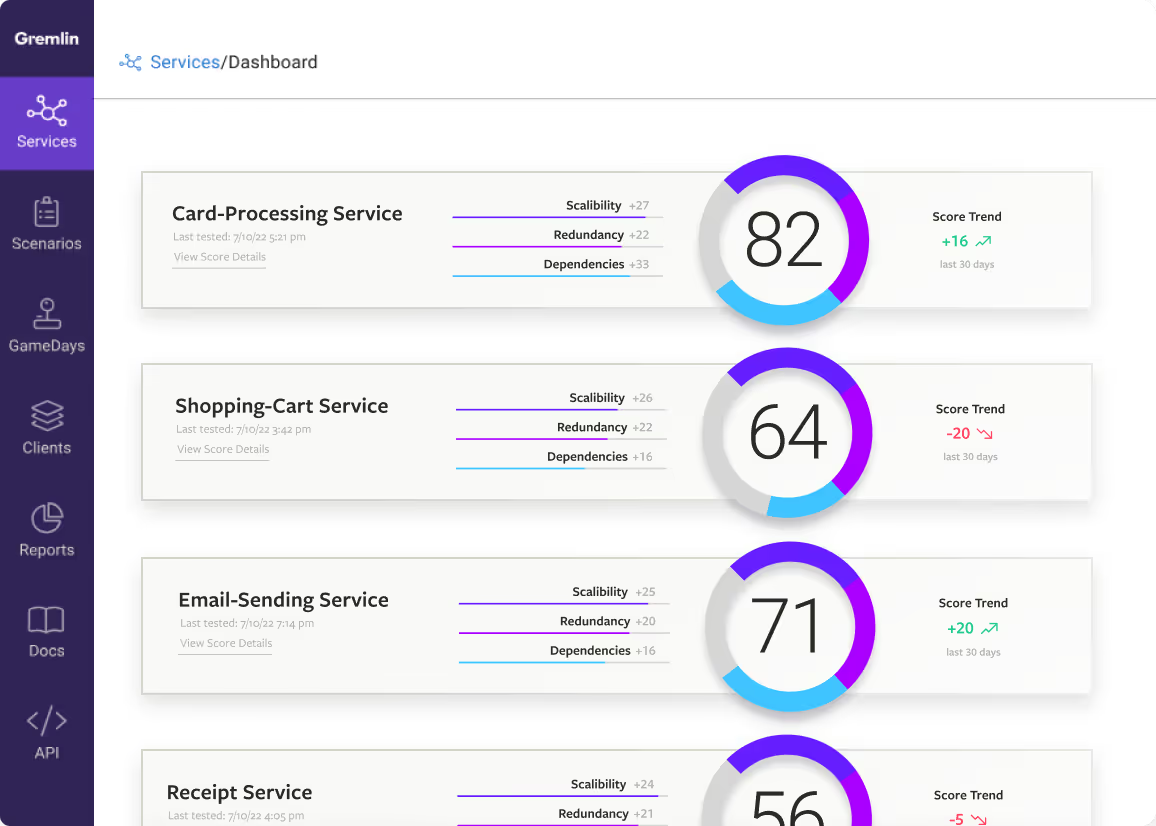
Gremlin also automatically detects reliability risks in your service configurations, maps service dependencies, and provides a standardized reliability score for each service. You can track those scores over time, benchmark them across teams, and prove to leadership that your reliability investments are paying off.
Gremlin works across AWS, Azure, GCP, Kubernetes, Linux and Windows hosts, serverless applications through Failure Flags, bare metal, and on-prem data centers. Gremlin’s customers include four of the five largest US banks and hundreds of Fortune 500 companies.

AI SRE tools apply large language model (LLM) agents to incident response. When an alert fires, the agent pulls evidence from logs, metrics, traces, recent deployments, and past incidents; tests hypotheses with follow-up queries; and provides root cause analyses to on-call engineers. Many tools can also write postmortems, open pull requests, or run runbook actions with an engineer’s approval. The AI SRE category includes AI-native startups such as Traversal, Resolve, Ciroos, Cleric, and Herald, and established observability and incident platforms such as Datadog, Rootly, Incident.io, and Dynatrace.
While each tool is different, they share one key design trait: their analyses are based on data your systems already produced. The depth and amount of the telemetry data you feed into these tools determines how effective they are at diagnosing problems: a detailed and effective analysis requires highly granular telemetry and integrations with the systems containing that telemetry. And while AI SRE tools are strong at recognizing known failure patterns, they’re less effective at diagnosing novel failure modes.
Where Gremlin and AI SRE tools diverge
Approach: reactive vs. proactive
AI SRE tools aim to reduce the time between identifying a problem and diagnosing a cause. However, they only start working when an alert fires or an incident is opened. By then, a potentially customer-facing problem has already happened. Faster recovery reduces the cost of each incident, but it doesn't reduce the number or likelihood of incidents.
Gremlin works before the alert by running safe failure tests against your services, automatically scanning your services for Detected Risks, and ranking the risks most likely to cause outages with Foresight AI. Gremlin flags your single-zone deployments, missing timeouts, and misconfigured autoscaling rules long before an alert fires. The Uptime Institute found that four in five serious outages could have been prevented with better management, process, and configuration, and Gremlin targets those gaps directly. Your systems are also constantly changing: every deployment, infrastructure change, and traffic shift can introduce new risks. Gremlin re-tests on a schedule, so you always know how much risk you carry today, not just what you learned from your last incident.
AI SRE tools make you faster at the incident loop. Gremlin keeps you out of it.
Data: historical telemetry vs. test-based evidence
AI SRE agents require data that your systems already emitted: logs, metrics, traces, deploy events, and past incident records. This makes them good at finding failure patterns your systems have shown before, but it also sets their limitations. If your platform only keeps 7 days of logs, or drops high-cardinality fields to reduce size and control costs, the agent has limited visibility. Even with good telemetry, frontier models correctly identified incident root causes only 56.2% of the time. To see that data, the agent needs access to your observability, incident, code, and deployment systems, which can mean a long security review. Gremlin only needs its agent on the hosts you test.
Gremlin generates the evidence instead of waiting for it. When you test a zone outage, a dependency failure, or added latency, you learn how your service responds to a failure it has never experienced in production before. Health Checks monitor your observability tools during each test and halt the test if your systems become unhealthy. Foresight AI doesn’t depend on your incident history either. Its recommendations draw on the Failure Atlas, Gremlin’s record of how real systems fail, built from more than ten years of failure testing. It can flag failure modes your systems have never shown you because it already knows about them.
AI SRE tools can only analyze failures that your systems have already experienced. Gremlin lets you find failure modes on your schedule, safely.
Resilience mechanisms: assumed vs. validated
If you’ve built failover, redundancy, autoscaling, circuit breakers, and disaster recovery plans, AI SRE tools can only guess whether any of them will work during an incident. The only proof they have is when a real failure triggers them, and by that point, you and your customers will have already felt the impact.
Gremlin tests each mechanism safely. Standardized test suites check each of your services against a common set of failure modes, showing whether your services can withstand those failures in production. Disaster Recovery Testing lets you recreate zone and region failures from a single screen, with auditable reports and actionable takeaways.
Your failover plan is an assumption until a real-world incident hits. Gremlin validates it before you need it.
Measurement: lagging vs. leading indicators
AI SRE tools focus on incidents: how many occurred, how quickly the team diagnosed the root cause, and how long they took to resolve. The problem is that these metrics are backwards-looking. MTTR can’t predict which service is likely to cause an outage, only how long it will take to fix. Even small incidents add up fast: a 15-minute outage every week adds up to 13 hours of downtime a year, which is well past what a 99.9% availability target allows.
Gremlin scores each service on a scale of 0–100% based on which reliability tests have passed and which configuration risks it automatically detected. These scores are based on standardized test suites shared across all services and roll up by team and company. Engineers can pinpoint specific risks for day-to-day work, and leadership can see the overall state of the environment and identify trends. A major U.S. insurance company used Gremlin to raise availability from 98% to 99% by fixing failure modes across 36 tier-one applications, cutting downtime in half. As your reliability scores increase and your incident counts drop, Gremlin shows you your progress over time and where your remaining risks are.
AI SRE tools measure how well you recover. Gremlin measures how likely you are to fail–and where.
AI agents: incident response vs. resilience
AI SRE tools and Gremlin both use supervised AI agents. The difference is when and how they run. AI SRE agents can diagnose problems, form hypotheses, and propose fixes after an incident has occurred, but these fixes might address the symptom without treating the underlying cause. This can lead to shorter incidents, but won’t prevent similar incidents from recurring.
Foresight AI finds risks before an incident happens, delivers a configuration diff that your team can deploy during a normal sprint, and re-tests the service to validate that the fix works. Gremlin continuously monitors your services for changes or regressions, and the Gremlin MCP server gives your AI tools access to your team’s reliability data so they understand how your systems can fail.
Google's DORA research tied a 25% increase in AI adoption to a 7.2% drop in delivery stability. AI SRE tools help you clean up after that instability, while Gremlin gives you an independent check on AI-generated changes before they reach your customers. The more code your team ships, the more incidents a reactive tool has to chase. Testing scales with your services instead of your incidents.
AI SRE agents fix the symptom once the alert fires. Foresight AI fixes risks in advance and proves each fix worked.
Which one is right for you?
- You want fewer incidents, not just faster recovery from incidents.
- You need proof that your failover, redundancy, and DR plans will work before a real failure tests them.
- You're accountable for reliability across multiple teams including on-call, and you need to benchmark and report on your reliability work to leadership.
- Your team ships AI-generated code and needs to ensure faster velocity won't negatively impact reliability.
- You need disaster recovery testing with auditable, compliance-ready reporting.
- Your on-call team is already spending a lot of time performing root cause investigations.
- You have high-fidelity telemetry with long retention for the agent to query.
- You want to shorten the time to draft postmortems and incident timelines.
Key Takeaway
AI SRE tools give you a faster fire engine to respond to incidents, and that’s valuable when you need to respond quickly. They cut investigation time, reduce on-call toil, and give your engineers a head start on resolving problems, but a fire still needs to start before they can take effect.
Gremlin is like improving your systems’ building codes so fires become less frequent and less severe. Gremlin tests your systems before an incident, scores every service on a uniform scale, and uses Foresight AI to find, fix, and prove risks ahead of time. If you want to respond faster, an AI SRE tool helps. If you want to avoid having to respond in the first place, that’s what Gremlin is for.
Teams with mature reliability practices will use both. Gremlin reduces the number of incidents your team has, and AI SRE tools shorten the length of the few incidents that do happen. Every risk you fix with Gremlin is one less investigation for your AI SRE agent and your team. Gremlin already connects to the monitoring and alerting tools your AI SRE uses, so failure tests show whether your alerts fire and your dashboards capture the right signals so your observability and AI SRE tools have better evidence when a real incident hits.
Frequently asked questions
AI SRE tools use large language models and other analysis techniques to investigate production incidents. When an alert fires, AI SRE tools use observability data (logs, metrics, and traces) to identify the root cause and streamline investigation. Some tools can also suggest remediations and draft postmortems.
No. AI SRE tools are designed to diagnose incidents after they’ve occurred. Gremlin is an agentic resilience testing and remediation platform that tests your systems and scores their reliability before an incident. Gremlin's Foresight AI agents work to find risks and recommend remediations in advance of production problems.
Foresight AI is Gremlin's agentic resilience product. Its supervised agents analyze and test your systems, propose fixes as config patches and IaC diffs, and re-run tests to prove each fix holds. It's grounded in the Failure Atlas, Gremlin's record of how real systems fail.
AI SRE agents start when an alert fires and reason from your existing telemetry. Foresight AI works before an incident, uses failure testing and the Failure Atlas to find risks, and proves each fix by re-running tests on your services.
AI SRE tools help you respond to incidents faster, which means they assume the incident happens. Foresight AI tests your systems to find failures before they reach customers, then proves the fix works. One speeds up recovery. The other prevents the incident.
Somewhat. Postmortems and incident patterns help your team avoid repeating known failures, but an AI SRE tool can only learn from failures that already happened. It can’t test whether your failover, redundancy, or disaster recovery plans work. Proving resilience to new failure modes requires proactive testing.
AI SRE and reliability testing tools solve different problems. AI SRE tools explain why something broke. Reliability testing shows what will break and confirms your resilience mechanisms work. Gremlin goes further than standalone failure testing by turning test results into a reliability score you can track across your organization.
Many teams do, by connecting an LLM to their logs and metrics. Gremlin’s MCP server gives those agents access to your reliability scores, test results, and detected risks, so they can reason about what will fail, not just what already did.
Yes, and the two work well together. Gremlin helps reduce the number of incidents that your AI SRE agent has to respond to, and for the few incidents that do happen, AI SRE can help resolve them faster. Foresight AI can also use the analyses and postmortems generated by your AI SRE to refine your test suite and validate your systems’ resilience.
Yes. Foresight AI runs supervised agents that analyze your services, recommend tests, explain results, deliver config patches and IaC diffs, and re-run tests to verify fixes. A native MCP server also bridges Gremlin's reliability data to the AI agents your team already uses. Gremlin never uses your system data to train models.
Gremlin has a free 30-day trial with access to the full platform.